Conductive materials and EMI/RFI shielding: how to choose
This category brings together different materials for electronics, wiring and EMI/RFI shielding. A conductive material, a conductive backing and a conductive adhesive are not synonyms: the first describes a material property, the second identifies the structural part that conducts, while the third refers to the adhesive’s ability to maintain an electrical connection between joined surfaces.
Before choosing, check whether you need a ready-to-use adhesive tape, a foil or sheet to cut and shape, or a fabric for shielding. For grounding and electrical continuity, distinguish the conductivity of the backing from that of the adhesive and verify the result on the real installation.
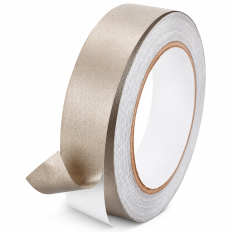
Conductive fabric tape with conductive adhesive
The double-sided EMI/RFI conductive fabric tape (ID 1635, SKU 902042) is a 20 mm × 10 m roll with conductive fabric and a declared conductive adhesive. The product sheet indicates it for EMI/RFI shielding, grounding, electrical continuity, electronics, prototyping and technical repairs.
It is the most direct choice in this category when adhesion and electrical continuity are needed in the same product. Actual performance depends on the surface, application pressure and conditions of use: for critical applications, check continuity with a suitable instrument after application. The sheet does not document numerical resistance, attenuation or frequency values, so they must not be assumed.
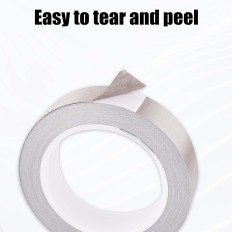
Adhesive copper: conductive backing and non-conductive adhesive
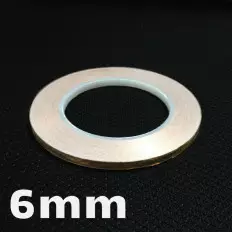
The adhesive copper foil (ID 201, SKU 222344) has a conductive copper backing and an acrylic adhesive declared non-conductive. Copper can conduct in its own plane, but the sheet does not document conduction through the adhesive or continuity along the Z axis.
It can be used for shielding and applications compatible with its declared characteristics, with available formats of 6, 10, 20 and 50 mm × 3 m. It must not be presented as equivalent to tape with an electrically conductive adhesive, and grounding through the adhesive must not be promised automatically.
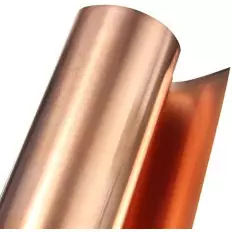
Pure copper sheet without adhesive
The pure copper sheet (ID 903, SKU 852154) is 99.9% copper, in a 0.1 × 200 × 1000 mm format. It is electrically and thermally conductive, but it is not adhesive.
It is suitable when a sheet must be cut, shaped or used in compatible technical work and applications. It should not be called adhesive tape, and descriptions referring to aluminium should not be carried over: the product in this category is copper.
Faraday fabrics for EMI/RF/RFID shielding
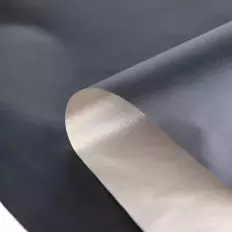
Faraday fabric ID 1198, SKU 1760115951777, and the Silver/Black version ID 1252, SKU 900650, are conductive copper/nickel-based fabrics according to their respective sheets. They are not adhesive: they must be applied or fixed with a system compatible with the project.
The sheets indicate them for EMI/RF/RFID shielding and signal blocking according to the declared characteristics. “Anti-radiation” is used here in the technical sense of shielding; it is not a health claim and does not promise health protection.
Comparison table of the 5 products
| Product |
Type |
Material/backing |
Adhesive |
Electrically conductive adhesive |
EMI/RFI shielding |
Electrical conductivity |
Format |
Indicative use |
| ID 1635 – SKU 902042 |
Fabric tape |
Conductive fabric |
Yes |
Yes |
Yes |
Yes |
20 mm × 10 m |
Shielding, grounding, continuity and electronic repairs |
| ID 201 – SKU 222344 |
Adhesive foil |
Copper |
Yes |
No |
Yes |
Yes |
6/10/20/50 mm × 3 m |
Shielding and applications compatible with insulating adhesive |
| ID 903 – SKU 852154 |
Non-adhesive sheet |
99.9% pure copper |
No |
No |
Not documented |
Yes |
0.1 × 200 × 1000 mm |
Fabrication, cutting and technical uses |
| ID 1198 – SKU 1760115951777 |
Faraday fabric |
Conductive copper/nickel-based material |
No |
No |
Yes |
Yes |
1000 mm × 1 m |
EMI/RF/RFID shielding |
| ID 1252 – SKU 900650 |
Silver/Black Faraday fabric |
Conductive copper/nickel-based material |
No |
No |
Yes |
Yes |
1000 mm × 1 m |
EMI/RF/RFID shielding |
Technical information
Backing conductivity means that the fabric or metal can carry current across its surface or through its body. Adhesive conductivity is a separate property: only when it is declared is it correct to describe continuity through the adhesive layer. Surface conduction, continuity through the adhesive and grounding are therefore different checks.
EMI/RFI shielding concerns reducing or containing electromagnetic and radio-frequency interference according to the material construction and its installation. It does not automatically mean a ground connection. When the project requires grounding, measure continuity on the real assembly and consider the backing, adhesive, pressure, surface and connections.
Electrical conductivity and thermal conductivity are different properties. Materials intended exclusively for thermal management remain outside this category and are not included in the table.
Indicative applications
- shielding enclosures, wiring and electronic components;
- technical repairs and prototyping;
- conductive connections when the adhesive is expressly declared conductive;
- use of copper sheets and foils in compatible fabrication work;
- EMI/RF/RFID shielding with non-adhesive Faraday fabrics.
Frequently asked questions
What is the difference between conductive tape and insulating tape?
Conductive tape is designed to provide an electrical function in the backing and, when declared, in the adhesive. Insulating tape has a dielectric function and must not be used as a conductive solution.
Does copper tape also conduct through the adhesive?
Not necessarily. In product ID 201 the acrylic adhesive is declared non-conductive; continuity through the adhesive is not documented.
What do EMI and RFI mean?
EMI means electromagnetic interference, while RFI means radio-frequency interference. Shielding depends on the material and the real installation.
When should I choose conductive fabric?
Choose fabric when flexibility and adaptation to surfaces or enclosures are important. If adhesion and electrical continuity are also required, check that the adhesive is declared conductive, as it is for ID 1635.
When should I use non-adhesive copper foil?
When a metal material must be cut, shaped or integrated with a separately selected fixing method. Product ID 903 does not include adhesive.
Are Faraday fabrics adhesive?
No. IDs 1198 and 1252 are non-adhesive conductive fabrics; the fixing method must be selected for the application.
How can I check electrical continuity after application?
Use a suitable measuring instrument and check the real assembly between the points that should be connected. Do not infer adhesive continuity from the presence of copper or conductive fabric alone.