
Your cart
There are no more items in your cart
If a room stays cold even with the heating on, you often don’t need a new boiler or a higher temperature. In most cases the heat is there, but it gets lost along the way: air in the radiators, furniture in front of them, cold walls soaking up the heat, draughts. Here are eight checks to do, in order, from the simplest to the most demanding.
Published on 28 September 2026
Guide contents
- 1. Hot at the bottom, cold at the top: there is air to bleed
- 2. Curtains, furniture and radiator covers hold the heat back
- 3. On external walls and in recesses the heat goes into the wall
- 4. Thermostatic valves need setting, not turning to maximum
- 5. Dust between the fins acts as insulation
- 6. If only the radiators near the boiler get hot, the system needs balancing
- 7. Draughts carry the heat away
- 8. At night, close shutters and curtains
1. Hot at the bottom, cold at the top: there is air to bleed
This is the most common problem at the start of the season. Air collects at the top of the radiator and the hot water can’t get there. You notice it with the heating on: the radiator is hot at the bottom and cold at the top. To bleed it, turn the heating off and wait until the radiator is cold: the air comes out more easily and you won’t risk scalding yourself with hot water. Then open the small bleed valve at the top, on the side, with a radiator key or a screwdriver, holding a cloth underneath. When air stops coming out and only water flows, close it again and turn the heating back on.
After bleeding several radiators, check the boiler pressure: if it has dropped below the value shown in the manual, it needs topping up.
2. Curtains, furniture and radiator covers hold the heat back
A radiator heats mainly by moving air: warm air rises and makes the air in the room circulate. A long curtain in front, a sofa pushed against it, a closed radiator cover or washing hung on it block this flow and the heat stays trapped near the wall. Keep at least the space above and in front of the radiator clear.
3. On external walls and in recesses the heat goes into the wall
A radiator also heats the wall behind it. If that wall faces outside, or if the radiator sits in a recess under the window where the wall is thinner, part of the heat goes into the wall and is lost outdoors.
The solution is to fit a heat reflective panel behind the radiator: the aluminium sends the heat back into the room and the insulating layer separates the radiator from the cold wall. It is also one of the tips from ENEA, the Italian energy agency, for spending less on heating. On an internal wall between two heated rooms it helps little.
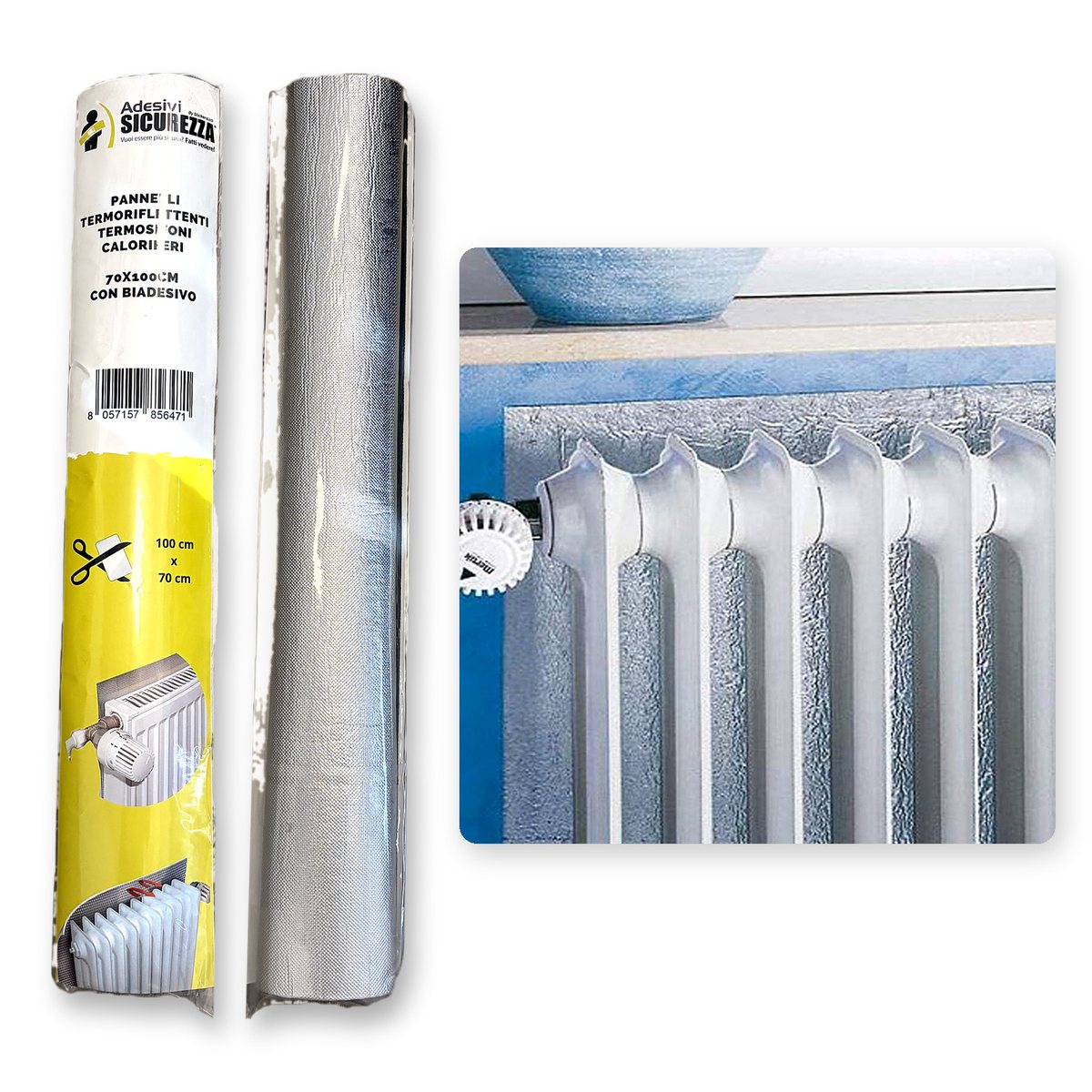
Our panels. The 70x100 cm heat reflective panel has adhesive already spread over the whole back: it goes on the wall in a minute, without removing the radiator, and doesn’t come off with the heat. For several radiators there is the pack of 5 panels; for stoves and stronger heat sources the 10 mm extra-thick version.
4. Thermostatic valves need setting, not turning to maximum
If your radiators have valves with numbers, the number sets the temperature you want in the room, not how fast it heats up. Keeping them all on maximum doesn’t heat faster: it only makes the boiler work harder. Better a middle setting in the rooms you live in and a lower one in rooms you rarely use, so the hot water goes where it is needed.
5. Dust between the fins acts as insulation
Dust builds up between the sections of the radiator, slowing down the heat and dirtying the air as it warms up. With the radiator cold, run a long thin brush between the sections, then vacuum.
6. If only the radiators near the boiler get hot, the system needs balancing
When the radiators furthest away stay lukewarm while the nearest ones are scorching, the hot water is taking the shortest route. Balancing the system means adjusting the lockshield valves, on the other side of each radiator: it is a job for an engineer, but it makes a big difference to the rooms further away. If a radiator stays cold even after bleeding, have the boiler and the cleanliness of the system checked.
7. Draughts carry the heat away
A window or door that doesn’t close properly lets cold air in all the time, and the radiator can’t keep up. Adhesive seals for doors and windows go on in a few minutes and stop draughts: you will find them in the Thermal and Acoustic Insulation Solutions category.
8. At night, close shutters and curtains
Windows are where a house loses the most heat. Closing shutters, blinds and curtains when it gets dark creates a layer of air that keeps the heat in the room. During the day, if the sun is out, open them: the sun heats for free.
In short
Before turning up the temperature, bleed the air, clear the radiator, remove the dust and set the valves. Then work on the heat that is lost: reflective panels behind radiators on external walls and in recesses, seals against draughts, shutters closed at night. If a room still stays cold, call an engineer to balance and check the system.